Showing posts with label The Wednesday Wars. Show all posts

Tuesday, December 18, 2012

Okay For Now by Gary D. Schmidt

The children and I had hardly finished listening to The Wednesday Wars. The tears were still fresh in my eyes, as was the echo of my son’s astounded question: “Ima, are you crying?!” I needed a moment to breathe, to recuperate, to taste fully of the enchantment of the book. But the children were adamant. We’re starting the next book, right now.

Since we loved The Wednesday Wars so much, our next choice was obvious. Okay For Now is by the same author and continues the story through the eyes of Doug Sweiteck, one of Holling’s friends. At first, however, perhaps because of how emotional I had gotten when finishing The Wednesday Wars, I had a hard time getting into Okay For Now. I didn’t like Doug’s voice. I didn’t like his family. I didn’t like that they were moving away. I didn’t like that Doug kept saying “stupid” about everything.

Doug, however, won me over. This sad kid, who tries so hard to act tough and not to look like a chump, is actually an endearing, smart boy who gently and quietly refuses to accept the labels put on him by most everyone in his new town. No matter how much Doug pretends to believe that things can’t get better, or that the people around him tell him he is bound never to succeed, an invincible streak of hope runs through him. He is willing to work hard, to try again and again, to put himself out there even in front of his Vietnam veteran PE coach and his condescending principal and carve out his own terrific and creative way in the world.

Okay For Now
is a very different book from The Wednesday Wars. Where Holling notices every little detail about the world, the war, his teachers, friends, and family, Doug’s world is an intimate one, and his skin is so fragile that everything touches a raw nerve. The Vietnam war enters into the story through Doug’s badly-wounded brother who Doug admires and yet from whom he yearns to be different. The town’s policeman and his many children, the grocer, the town’s biggest employer, the librarians, the teachers, the famous playwright who lives isolated at the edge of town, and Doug’s family members -- they all come to life through Doug’s interactions with them.

A boy Doug’s age would be fifty eight today, and I know it is silly to worry about a kid who not only is a character in a book, but would also be older than me if he really lived. But I can’t help myself. I want to know that Doug is okay. Not just for the now of the book, but for always. I hope he grew up to continue to do well at school. That he became an artist. That he married his childhood sweetheart and had five kids of his own. And I realize why it is I loved Doug so much. It is because his character’s defining quality is forgiveness. Doug gives everyone, and most especially himself, a chance. Not just a second chance or a third chance, but as many chances as they need. And so Doug gets a chance, and being Doug, good natured, intelligent, open-hearted and hopeful, he always makes the very best out of it.


Friday, December 14, 2012

Literary Relativity

My aunt and uncle are the most loyal readers and supporters of my blog. They engage me in conversation on what I wrote and often take my book recommendations. My uncle always “likes” my blog on Facebook, and they both treat my philosophical meanderings seriously.

I love talking about books, and so I adore it when my aunt and uncle read the books I recommend. I had discussions with them on Fifty Shades of Grey on one side of the literary spectrum and Percy Jackson on the other, and I’m still looking forward to hearing what they think about Nine Rules to Break When Romancing a Rake. Last week, they told me they had been reading Gary Schmidt’s The Wednesday Wars.

“I want to talk to you about this book,” my aunt said. “I can’t believe you think it’s the best book you’ve read. I’m enjoying it, but I want to know what makes you say that.” A few days later, my uncle, having finished the book, said: “It’s a good book, but it’s not the best book I’ve ever read.”

The Wednesday Wars is, at the very least, a great book. The novel won the 2008 Newbery Honor medal, after all. It got 4.5 stars on Amazon and 4.1 on Goodreads, a fabulous review on the New York Times and starred reviews on both Kirkus and Booklist. And what’s more: my kids loved it, so much so that my daughter and I are now listening to it again, and the three of us together are on our third Gary Schmidt novel.

But of course that is not what my aunt and uncle meant. They wanted to know what in the novel resonated so strongly with me that I made my “best book” claim because the novel did not resonate with them the same. And yet, I cannot quite put my finger on an explanation. All I know is I cried and laughed, often at the same time. I felt my heart beating in time with Holling. I rooted for him, cared for him, wished him well. And not only him, but all the characters in the novel, from Mrs. Bigio in the kitchen mourning her dead husband and baking cream puffs to Holling’s sister running away from home.

A book is a vessel, a channel to express our feelings, thoughts, and needs. The details in it act like the fibers of a sponge, allowing space in which to unload whatever it is we have been carrying and maybe gain new insights. I am reading The Wednesday Wars again, looking for what it is, precisely, that so caught my heart. What made me care so much, as though these characters were my friends, my family? What is it I identified with so strongly? If I find, I will let you know. But I think, perhaps, it is the mystery of the letters on the page, the combination of them into words, the energy that hides in them that creates this literary relativity and makes one of us fall hopelessly in love while others don’t make any fuss at all.

Here's the link to the NYT article about the book.

Tuesday, November 13, 2012

Description’s Noiseless, Unseen Tread

I was a voracious reader growing up. I often say that my best memories are of my mother, my sister and I going to the library, scanning the shelves, searching for new books, and later carrying a huge, tottering pile full of promise to the car. As a young girl I devoured The Count of Monte Cristo, Three Men in a Boat, The Hobbit, My Family and Other Relatives, All Creatures Great and Small, and The Red and The Black. My mother used to tell me to read the first 100 pages before deciding if I’m interested in a book, and not surprisingly, I finished reading almost every novel I began.

Recently, I decided I wanted to read Three Men in a Boat again. The novel is filled with poetic, rambling nature descriptions such as this one: “From the dim woods on either bank, Night’s ghostly army, the grey shadows, creep out with noiseless tread to chase away the lingering rearguard of the light, and pass, with noiseless, unseen feet, above the waving river-grass, and through the sighing rushes; and Night, upon her sombre throne, folds her black wings above the darkening world, and, from her phantom palace, lit by the pale stars, reigns in silence.” (Chapter 2).

Shockingly, I find that now, at age 40, I have less patience for nature descriptions than I did at age 14. All I want is action. I pick through exposition to find Harris attacked by the swan or losing his way in the maze, Jerome burying the cheeses on the beach or taking a young lady on a boat ride, or even George trying out the banjo. Anything seems to me more interesting than wallowing in a description of night. And yet I love Jerome K. Jerome’s descriptions. I love his lyrical prose, his light, ironic touch, how he seems to make fun of himself and his comrades while giving an articulate description of the English countryside.

In Gary Schmidt’s The Wednesday Wars, Holling’s teacher Mrs. Baker assigns him Hamlet. Holling says the tragedy is pretty good, if you skip all the long speeches. His friend Meryl Lee objects:

“You can't just skip the boring parts."

"Of course I can skip the boring parts."
"How do you know they're boring if you don't read them?"
"I can tell."
"Then you can't say you've read the whole play."
"I think I can live a happy life, Meryl Lee, even if I don't read the boring parts of The Tragedy of Hamlet, Prince of Denmark."
"Who knows?" she said. "Maybe you can't.”

These days, novels brim with action. Descriptions take second place -- a distant, less conspicuous second place. Writers are told again and again: “Show, don’t tell!” And yet the description above adds a lot of meaning to Jerome’s romantic, indolent character. I can tell how happy he is just to lie around and look around him, and when I stop rushing ahead to the next action scene I have to admit: I am perfectly content to sit there with him, watching Night as she folds her black wings. Living the happy, description-full life.

Tuesday, November 6, 2012

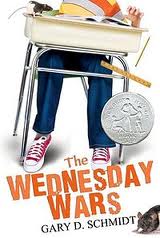
OK, So It’s a Panegyric of Gary Schmidt’s The Wednesday Wars


I did not want the novel to end. Actually, that might not be an accurate description of my emotions as Joel Johnstone, the audio book narrator, neared the conclusion of Gary Schmidt’s The Wednesday Wars. The kids and I have been listening to the novel for the past few weeks, laughing and crying, discussing Vietnam and Shakespeare, and loving every moment. Today, however, we had to say good bye. Laughing helped a little to choke down the tears that burned at the corner of my eyes and the sadness which tightened my throat as the story wound, inexorably, to its end.

What a beautiful, beautiful story! A whole, wide, wondrous world! Racial tensions, war, family, competition, ambition, fear, love, friendship, white feathers and yellow tights, miracles and brown, perfect cream puffs. Holling Hoodhood, the protagonist, tells us of negotiating a world strewn with rules, disappointments, and unexpected events, both good and bad. As a seventh grader, he is perched on the rim of growing up, and he notices everything that happens around him, understanding people (and sometimes misunderstanding them) with touching sensitivity and straight-forward, often self-deprecating expression.

My favorites are the unlikely friendships born in the novel: Holling and his eye-rolling teacher Mrs. Baker (despite the fact that Holling is certain that she hates his guts). Holling’s classmate Mai Thi, the tough Vietnamese girl who was sponsored over to the U.S. by the Catholic Relief Agency, and Mrs. Bigio, the school’s cook whose husband dies in Vietnam. Holling and Meryl Lee, whose fathers’ have competing architectural firms (I can see Hoodhood and Associates and Kowalski and Associates becoming Hoodhood, Kowalski and Associates in a few years). Holling and his sister Heather, who wishes to be a flower child and change the world and who leaves their house (the Perfect Home, as Holling calls it satirically) to find herself.

Some books I read once, and it is enough, but not this one. Having heard it on audio, I would now like to read it on paper and see if it is the same. There are so many details there, so many undercurrents in every word, that I expect I shall find it quite different. I love Joel Johnstone’s reading. I love how I can hear Mrs. Baker’s sarcasm dripping when she corrects Holling’s grammar. I love Danny Hupfer’s breaking voice. I love Holling’s multicolor way of speaking, depending, of course, on who he is speaking to and whether or not he is feeling threatened.

And in honor of Gary Schmidt’s powerful writing, I love the cream puffs, the escaped rats, Mrs. Sidman’s yellow rain jacket, Doug Sweiteck’s penitentiary-heading brother, and the many other colorful, fabulously portrayed characters. I will forever think of Mrs. Baker waiting for strawberries, and Mrs. Bigio opening her heart to the young Vietnamese girl. And above them all, sternly ruling, the ghost of William Shakespeare, with an answer for every question on life, and his best contribution to swear words, the ultimate: “Toad, beetles, bats!”

The Wednesday Wars on Audible
The Wednesday Wars on Amazon
The Wednesday Wars on Goodreads
Gary Schmidt's Website