Showing posts with label middle grade novels. Show all posts

Tuesday, November 6, 2012

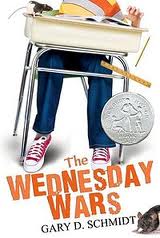
OK, So It’s a Panegyric of Gary Schmidt’s The Wednesday Wars


I did not want the novel to end. Actually, that might not be an accurate description of my emotions as Joel Johnstone, the audio book narrator, neared the conclusion of Gary Schmidt’s The Wednesday Wars. The kids and I have been listening to the novel for the past few weeks, laughing and crying, discussing Vietnam and Shakespeare, and loving every moment. Today, however, we had to say good bye. Laughing helped a little to choke down the tears that burned at the corner of my eyes and the sadness which tightened my throat as the story wound, inexorably, to its end.

What a beautiful, beautiful story! A whole, wide, wondrous world! Racial tensions, war, family, competition, ambition, fear, love, friendship, white feathers and yellow tights, miracles and brown, perfect cream puffs. Holling Hoodhood, the protagonist, tells us of negotiating a world strewn with rules, disappointments, and unexpected events, both good and bad. As a seventh grader, he is perched on the rim of growing up, and he notices everything that happens around him, understanding people (and sometimes misunderstanding them) with touching sensitivity and straight-forward, often self-deprecating expression.

My favorites are the unlikely friendships born in the novel: Holling and his eye-rolling teacher Mrs. Baker (despite the fact that Holling is certain that she hates his guts). Holling’s classmate Mai Thi, the tough Vietnamese girl who was sponsored over to the U.S. by the Catholic Relief Agency, and Mrs. Bigio, the school’s cook whose husband dies in Vietnam. Holling and Meryl Lee, whose fathers’ have competing architectural firms (I can see Hoodhood and Associates and Kowalski and Associates becoming Hoodhood, Kowalski and Associates in a few years). Holling and his sister Heather, who wishes to be a flower child and change the world and who leaves their house (the Perfect Home, as Holling calls it satirically) to find herself.

Some books I read once, and it is enough, but not this one. Having heard it on audio, I would now like to read it on paper and see if it is the same. There are so many details there, so many undercurrents in every word, that I expect I shall find it quite different. I love Joel Johnstone’s reading. I love how I can hear Mrs. Baker’s sarcasm dripping when she corrects Holling’s grammar. I love Danny Hupfer’s breaking voice. I love Holling’s multicolor way of speaking, depending, of course, on who he is speaking to and whether or not he is feeling threatened.

And in honor of Gary Schmidt’s powerful writing, I love the cream puffs, the escaped rats, Mrs. Sidman’s yellow rain jacket, Doug Sweiteck’s penitentiary-heading brother, and the many other colorful, fabulously portrayed characters. I will forever think of Mrs. Baker waiting for strawberries, and Mrs. Bigio opening her heart to the young Vietnamese girl. And above them all, sternly ruling, the ghost of William Shakespeare, with an answer for every question on life, and his best contribution to swear words, the ultimate: “Toad, beetles, bats!”

The Wednesday Wars on Audible
The Wednesday Wars on Amazon
The Wednesday Wars on Goodreads
Gary Schmidt's Website

Saturday, August 18, 2012

The Wonder of Wonder

Some books stay with me forever. These are the books that touch my heart, making me laugh while I have tears in my eyes, the books that teach me something deep about human longing, about my own need to be the best human being I can. Most of the time I read for the pleasure of being in a new world, for forgetting what’s bothering me in this one. But once in a while there comes a book which so innately speaks to me, that it gives me a new perspective about my life.

Last week, the children and I finished listening together to the audio version of Wonder by R. J. Palacio. Have you ever felt that sense of emptiness when a book ends? Not a second passed after the last word and my son asked: “Is there Wonder Two?” But the novel has only come out this February, and there is no hint in R. J. Palacio’s website for a sequel.

Wonder tells the story of August Pullman’s fifth grade year through the eyes of six different young people: Auggie, his friends Summer and Jack, his sister Olivia, Olivia’s boyfriend Justin, and Olivia’s friend Miranda. Each voice gives a unique and distinct perspective of Auggie’s story as he struggles to acclimate to school. Auggie has never been to school before. He was born with a terrible genetic facial deformity for which he had numerous surgeries and which had prevented him from going to school so far.

The novel begins with Auggie, and I found myself sucked into his story, weeping for his difficulties and identifying with his pain as he stumbles into the cruel and inhospitable environment of a regular school. The children avoid touching him or speaking to him, rushing to wash their hands if he accidentally brushes against them. Only two children befriend Auggie, and when one of them betrays his trust, I felt Auggie’s sorrow as though it was my own.

Then Olivia, August’s sister, started to speak, and my perception of the world changed. With no hint of emotion, Olivia detailed Auggie’s deformed face and the various genetic disorders that conspired to make him look the way he looked. Listening to her, I finally understood the shambles that were August’s face, how near he had been to death, how miraculous that he could even eat by himself. But Olivia did not show me just Auggie. She showed me herself, Olivia, the older, healthy sister who must hide who she is and what she needs because her world, inevitably, revolves around Auggie.

More and more perspectives added intricate layers of insight into this year in Auggie’s life as he grows up and matures and his world opens up before him. I laughed and cried. I held my breath. I fell in love with Auggie, Olivia and all their friends, even with Mr. Tushman the school’s principal and with Mr. Browne and his Precepts. And I loved that my children identified with Auggie so much, that for them it was not a story about a deformed kid, but the story of a kid they could love.

My favorite precept: "Just follow the day and reach for the sun." ~ The Polyphonic Spree


Find Wonder on Goodreads.

Friday, August 17, 2012

Interview with Author Eric Sandler

Today I am hosting author Eric Sandler on my blog. Eric and I met at the SCBWI conference where we found ourselves engaged in a discussion of horror writing across the Golden Kite Luncheon table, of all things.

Hi Eric, I'm so glad to have you interviewing on my blog today! I'm curious to know, writers often say that they write because they have to write. Do you see writing as a hobby or a vocation?

Vocation for sure. It certainly started as a hobby back when I was 12-13, writing fanfiction for newsgroups. As the years went on I started developing my own characters and stories and became more serious about getting published. Now my one goal in life is to see my name on a book I wrote. After that's accomplished...I write the sequel.

Tell us about the world of your fantasy novel.

It's not so much 'world' as 'worlds.' One of the main characters has the ability to travel to other universes, and so it's about as far from Earth as you can get. Many of the worlds they visit are behind modern-day Earth in terms of technology and have entirely new species of animals and some varying laws of physics. Some worlds have magic, but that isn't used too much, so my apologies to the Harry Potter fans.

Where is your favorite place to write?

Outdoors. I tend to take my netbook and sit outside in the backyard, assuming it's not too hot (which it has been these last few days, so I'm behind!)

I’m with you on writing outdoors. But what do you do if it rains?

Fortunately, the deck has an awning that covers the whole thing, so I can write rain or shine!
Eric's outside writing place

What is your writing routine like?

I have two computers, a netbook and a desktop. The desktop is for general use, the netbook for writing. For proper work to get done, I get away from the desktop. Preferably to a place without wireless Internet. I usually play music while I'm writing. Anything with a good beat that helps me think is in my playlist, so I tend to have a mishmash of artists. Overall it's probably half Japanese music, half American artists.

What kinds of songs would you put on a playlist for your novel?


A mix of Japanese and American artists. Scandal, High and Mighty Color, m.o.v.e., YUI, Hamasaki Ayumi, Paramore, Evanescence, Bon Jovi, and several more scattered amidst individual songs.

You listen to Japanese music and speak Japanese. Have you ever lived in Japan? Do you use the language or culture in your novel?


Yes, I lived in Osaka for almost three years. I attended a language school there to study Japanese, and then taught English after graduating. I don't use Japanese so much in this novel, but I'm planning to use it in a middle-grade novel I'm currently writing. The main character is Japanese whose grandparents are from--of course--Osaka.

Did you like to read as a child?

I devoured books as a kid. Ender's Game and The Giver are two I read over and over. The latter I read a few years ago and was startled at certain parts that I could understand more clearly now as an adult. It made the whole thing much creepier. Ender's Game remains more or less the same, but I still find it entertaining to read.

I love
Ender’s Game and The Giver. Do you have other books you feel influenced you as a writer?

Ender's Game is definitely a book I've read over and over. Bruce Coville and R.L. Stine likely are my biggest influences. I loved Jeremy Thatcher, Dragon Hatcher, and I read the Fear Street and Goosebumps series despite getting scared at Night of the Living Dummy. That one book will make me look askance at mannequins for the rest of my life...

Any thoughts about why kids like scary books?

When I was a kid, I read a lot of R.L. Stine, Christopher Pike, etc. Despite sometimes scaring me into having nightmares, these books gave me a glimpse into the darkness that is our fears. I think there's a subconscious attraction to that fear, as it gives us a peek into the unknown.

Have you had any stories, articles or poems published in magazines?

Yes, I've had a short story published on welltoldtales.com, and that same story won second place in the West Side Story contest (now defunct) as well as an honorable mention by Writer's Digest in their Popular Fiction contest. So that one story's really gotten around.

That’s so fabulous! Do you have advice to other writers who are still on their way to see their words in print?


Start writing. You can't get published without putting pen to paper (or typing that first word). Follow through. Starting and finishing are the two most important parts of writing, because without that, you can't move forward. Be prepared to edit, a lot. And I mean A LOT. This is before you even find an agent or editor. Find someone to beta-read your work (not a friend or family member) after you've gone through and edited the whole thing 3-4 times. It helps so much to have a fresh, outside perspective. Be prepared to take a lot of criticism. Accept that you can't write it perfect the first time and will likely have to do several passes before it's even close to submission-quality. Joining a critique group can also help a lot, but I personally haven't had that experience.

Thanks Eric for visiting and answering my questions!
You can follow Eric on twitter at @EricSandlerYA

If you have any questions or comments to Eric, please feel free to comment below.

We LOVE your comments.

If you're a writer and would like to be interviewed on my blog, please comment below, or send an email to stzoore (at) yahoo (dot) com.

Monday, August 6, 2012

Interview with Writer, Fencer and Teacher Laura Clement

Today I have writer Laura Clement interviewing with me. Laura and I met at an SCBWI conference a few years ago and have stayed in touch through facebook, of all places. SCBWI is a great place to meet new friends and learn more about writing and illustrating for children. I'm very excited to have Laura with us today.

Hi Laura, Thanks for joining me! Can you tell me about the path you followed to become a children’s books writer?

Through my process of writing, something I have been doing since grade school, starting with poetry, I struggled with the lines that are drawn between children’s literature and adult literature. When I have a chance to talk to other writers, some who have published over 300 books (children’s) and a few novels, I hear the same thing over and over again -- Just write. One writer told me, “I never change my writing for kids. They are smart and love a challenge.”

I think for me the major difference is subject matter and the depth to which you might take it. One of my books for kids might be about depression, but I won’t tackle it in the same way I do in my novel. But they both have the same heavy topic. I think it is harder to write for kids. The book has to seem so simple and flow with effortless grace, this is HARD work. A great kids' book is something everyone will enjoy, kids to adults.


That’s so true. You write picture books and middle-grade novels, is that right?

I love writing picture books, chapter books, middle grade novels. I love to try anything. I still visit poetry from time to time. I let the characters find me, and once they start chatting in my head, or images of them fill my unconscious dream world and dance into day, they get placed to the page. I like adventure stories where the reader has to set outside their world.

Do your books have a message for kids?

Yes.  Martin the Mouse (working title) is about finding your inner strength, exploring the world beyond your own eyes and taking chances. Sky and Sparrow (working title) is about the adventure between two characters and the fun they can have in the moment of a day. My polka dot adventure is about seeing the world from a different perspective and maybe incorporating it into your life.


You fence and teach kids fencing. Have you used your fencing knowledge in your books?

Laura fencing with her husband, Martin
I have!  I am currently rewriting a middle grade novel about a fabulous little mouse and her sister who learn to fence. What can I say, one night I was sitting in the salle (club), and I watched a mouse run across the floor. That got me to thinking about how mice see us and what they do when we are not there.


In between work and fencing, how do you find time to write?

I have been really lucky. Until recently I was able to work from home, set up a schedule and pound out ideas and edit… edit…edit. This summer has been very difficult. Between working all day teaching kids, and then family being in town, I haven’t had any time to write. Though I have some fabulous new ideas and new approaches for old projects spinning around in my head for when September rolls around and I can get back to a schedule. A writer needs a schedule. Even if it is only one hour a week, if that time is the same every week, you can totally get work done.


I’ve heard other writers recommend that before. You’ve been on the track to finding a home for your books for some time now sending queries. How do you handle the inevitable rejection letter?
 
I have all of my rejections filed away, mostly electronically, date stamped in a spreadsheet with any comments listed at the end. I am at the point where I am frustrated by rejection letters that don’t say anything useful. But for the most part I just turn my focus back to a current project and try to keep rolling. Sometimes if I get it late in the day I let myself have a nice cocktail or something sweet (hello cupcakes).

That’s fabulous! Which books do you remember the most when growing up?

Mrs. Piggle Wiggle, The Fledgling, Lord of the Rings (my godfather read that to me), Anne of Green Gables, The Eyes of the Amaryllis….  The list could go on… Oh!  Wait, The White Dragon (well all of the books from Anne McCaffery), and of course A Wrinkle in Time.


Which author do you think influenced you most into becoming a writer?

All of them- Any writer or book that took me places.

 Do you have advice to other writers?

Advice… Write for you, for your characters, for the laughs you get when one of them says something funny. Write for your friends or family who love to read your adventures. The rest is major work and just needs to be done (research of agents/publishers). Make sure you write more than you do the “work” or as I discovered, you burn out. Keep your love of writing alive and for goodness sake, find a really good critique group (easier said than done I know).


Thank you, Laura, so much for interviewing with me! 

You can find Laura on Facebook as Laura Clement (Seattle) and Clement Creations, on twitter as @clementcreation, and on her blog.


We love your comments! Please feel free to ask Laura (or me) any questions. If you too are a pre-published writer and would like to be interviewed on my blog, please mention it in the comments or send me an email to stzoore (at) yahoo (dot) com.

4TN898KV3Q4G

Monday, May 7, 2012

Faith Makes the Luck, By The Great Horn Spoon!

Last year, my son recommended that I read Sid Fleischman’s novel By the Great Horn Spoon. He had read it in class as part of the Gold Rush unit and enjoyed it. I agreed but did not immediately follow up on my promise. The picture on the cover showed a muscular bearded man battling a hairy giant. Wrestling is not my favorite topic, nor do I feel particularly enthralled by the gold rush (though I am a huge Jack London fan). After a lot of enthusiastic prodding by the young reader, I finally picked up the book last week and started to read. And I’m so glad I did!

By the Great Horn Spoon is one of those rare books that encourages free thought, creative problem solving skills and faith in oneself. Jack, the main character is a young boy who leaves for California during the gold rush in order to find enough gold to allow his Aunt Arabella to keep her house in Boston. He is accompanied by his butler, Praiseworthy, who discovers Jack’s plot to run away to California and decides to help him.

Praiseworthy and Jack run into many adventures and twists of fate, but they always find resourceful ways to deal with obstacles, whether they are concealing themselves in potato barrels on the ship after their fare money is stolen, rescuing a pig from being butchered and eaten, searching for a treasure map, or digging a grave. And luck follows in their footsteps as though it already knows that resistance is futile: if one thing won’t work the partners will try another, till they strike it rich and rescue Aunt Arabella’s house and memories from being sold.

Jack is faithful to his friends and ever ready to try something new, even if it is bitter coffee mixed with ground acorn. He is a curious boy, hardworking, and brave. But it is Praiseworthy who I found to be a character to remember and learn from.

My favorite scene turned out to be the one illustrated on the cover. Praiseworthy has never wrestled anyone, but he has confidence in his abilities to beat the Mountain Ox who “had a neck like the stump of a tree” and whose chest looked “as big around as a flour barrel.” And why? Because “it stands to reason that the Mountain Ox never read a book in his life. He’s no doubt a mere brawler.” Praiseworthy, himself a great reader, had  back in Boston read a book about boxing, and he intends to use that knowledge to good purpose. As he explains: “since I’ve outread him, I see no reason why I can’t outwit and outbox him.”

To Praiseworthy, the knowledge acquired by reading is empowering. As a reader and a writer, I believe that is true. I love books that inspire me and lead me to trust in myself and my talents, and By the Great Horn Spoon sure does both.

Tuesday, May 1, 2012

My Hectic Life in Books


Lately I’ve been reading five or six books at a time. Two books on the iphone, alternating whenever I have a break between appointments. One book on the ipad while eating my breakfast. One paperback ready in my secret escape haven, the bathroom, and another next to my bed. And two books, non-fiction, I haven’t been able to finish yet.

Two romance novels: a historical romance in which aristocratic Anthony is trying to seduce school-teacher Madeline, and a time-travel romance in which Sara is thrown back two hundred years in time to a gypsy camp to find her one true love. The paperback next to my bed is a middle grade novel recommended by my son. Young Jack and his butler travel to California to find gold in order to help the boy’s aunt keep her home. On the ipad: an adventure novella about two assassins trying to end slavery while falling in love. My serious reading: a book about meditation and another about will power. Just what I need. And last, a book detailing the historical travels of a collection of miniatures from Japan. I haven’t fallen head over heels with that one.

So many characters and their various escapades swirl in my head. Was it Toma the gypsy who hid the pig in a tent, or Master Jack who stuffed it out a porthole? Is Madeline the one whose father is ill or Sara? And which heroine is the really gorgeous sixteen years old who keeps her face covered at all times?


I guess I have high expectations of my memory, to keep all these people and events, their families, looks, and characters straight in my mind. Perhaps if that was all I tried to remember, I’d be fine. But I expect yet more. I’ve been planning three novels at the same time while attempting to revise another. I keep all my appointments in memory -- I write them down too, but I rarely recheck my calendar to make sure that my memory was right. And let’s not mention the piles upon piles of forgotten papers on my desk, the stuffed animals and other toys the kids have left there, and our camera, with photos from our last two trips still inside (yet another characteristic hoarding of details instead of uploading them into a better safekeeping device).


Oh dear. My life is chaotic beyond belief or relief! Why can’t I just read one book at a time? Keep one novel to write at a time in my head. Clear the desk, check the calendar, free my memory of all the phone numbers that have been gone almost thirty years ago (09-448-624 was our family’s phone number when I grew up). Perhaps it is time for me to clear my head and my desk of this unhelpful stuff. But at least in books, I find that sheer number adds to my excitement of life.

What books are you reading now?

Sunday, January 22, 2012

Thoughts About Joy and Angst

An agent once told me that the difference between young adult and middle grade fiction is sex and angst. As a general guideline, young adult novels are aimed at teenagers fourteen and above, while middle grade novels are written for the 9-13 crowd. This division exists from bookstore all the way down through publishing houses and literary agencies, to the writer who sits at home and writes. You might think that distinguishing between teenagers and pre-teens means that young adult novels deal with more complex, adult themes than middle grade. This is true, but not always. Most often I find that YAs really do have the obvious and double advantage of focusing on sex and angst.

So what is angst? I looked it up in the urban dictionary and found these definitions: “Angst...combines the unbearable anguish of life with the hopes of overcoming this seemingly impossible situation.” And specifically about teens: “Angst is about downtrodden teenagers thinking they’re the only bloody people in the world who have it tough, and think that gives them an excuse to wallow in their own self-pity instead of actually doing something about their situation.” Pretty serious wording. Do teenagers really feel like that?

I have an image of myself as a teenager. I think at least in my last two years of high school I suffered from depression. I remember myself mostly painting in my bedroom, listening to Shlomo Artzi on my tape recorder. As a two-time transplant (Israel to South Africa to California in three years), I too carried the weight of the world. I felt like I didn’t belong either with other kids from my class or with the pack of Israeli Tzofim (scouts) who made up my main source of social life. Anguish? Yes. Downtrodden? Yes. Impossible, unbearable and alone.

But here’s the thing. I write to you today in this blog whose name is “Lil’ Corner of Joy,” and to tell you the truth, I don’t want to write about angst. What I want to write about is the diamonds that hide in all of our lives, the precious moments of utter being, of pure pleasure, that make everything else worthwhile. I don’t want to add more negativity to a world already beset by newspaper gossip and televised violence. I want my writing to be a haven, a bubble of peace in the midst of life, a place to rest the mind and come out rejuvenated, inspired, loved.

I’m an idealist. I am also really good at burying my head, ostrich-like, in the ground. The world needs its share of social revolution and political reform, but it also requires dreamers. Like Leo Lionni’s Frederick, the mouse who collects the rays of the sun, the colors of the flowers, and words to help his fellow mice survive winter, I believe food for the soul can make a difference in the world as great, or greater, than any struggle.