Thursday, November 8, 2012

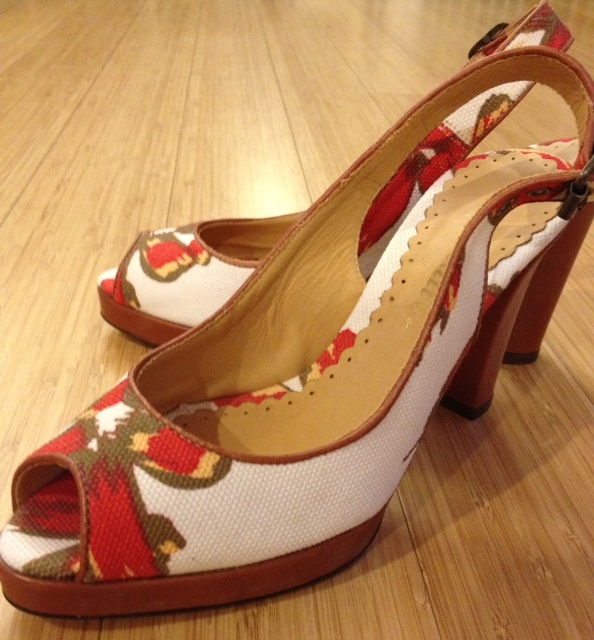
Dazzling, Wonderful Shoes!

The blog today is in honor of the marvelous Bridgey who introduced me to the best shoe shops in the area and encouraged me to buy as many pairs as I like. 

I am not a dressing-up kind of gal. I wear the same shoes (sneakers) and hiking or workout clothes every day. My dressiest pair of pants are jeans, and my dressiest shirts are t-shirts. I rarely wear jewelry (though lately I’ve taken to wearing a gold necklace with a merlinite pendant round my neck), and I never, ever put on make-up or perfume. I suppose I should also confess that I keep myself warm with the same two hiking-style jackets, one of which my mother hates because of a large brown stain on the back from when Eden accidentally painted me.

Despite this, you might be surprised to learn that I own quite a few pairs of high-heel shoes. And I don’t mean just one or two. I have a pink, floral pair that I bought for my cousin’s wedding and worn that one time. I have a platformed black sandal that makes me feel tall and thin, and another black, elegant, shiny sandal. My grandma bought me a fabulous pair in yellow and tan -- worn once. I have a red platformed pair -- still brand new. I have one in sparkly purple that Eden decided she hates, and another classic black pump which pinches my foot terribly. And there’s my favorite one: silvery-grey with black dots, surprisingly comfy.

 So what does a plain-dressing gal who wears hiking clothes and prefers flat sneakers (the flatter the better) want with so many pairs of (shall I confess it?) expensive, stylish shoes? Well, perhaps I too have a vain streak, an “oh my gosh I love looking hot” vein in my practical body. And perhaps I also love, just once in a while, and no more than once a year, to dress up in a tight-fitting dress and to add to it a pair of sexy heels. But more true than that would be an equally embarrassing confession: I just really really love shopping for shoes.

Remember the scene from Roman Holiday, where Audrey Hepburn (who plays a visiting princess) removes her shoe and cannot find it again under her dress? There’s just something about shoes, even if they are partly or completely hidden beneath clothes. They can make us tall, stable, comfortable or uncomfortable, elegant or dowdy. They can make our calves look sexy, lengthen our legs, give an unforgettable accent to an outfit. Can you imagine a cowboy with sneakers? A president in clogs?

My shoes, though kept hidden in the closet, remind me of an aspect of my personality that I rarely acknowledge: the coquetish, girly part of me that likes to dress up and wants to look beautiful, and that enjoys so much when Dar says, “Wow!” or Eden says, “Ima, you look good today!” The practical me prefers to dress in comfort. The sexy woman in me says, “Wear that jacket with the stains, but you have to have the shoes’ support behind you!”

Tuesday, November 6, 2012

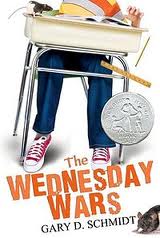
OK, So It’s a Panegyric of Gary Schmidt’s The Wednesday Wars


I did not want the novel to end. Actually, that might not be an accurate description of my emotions as Joel Johnstone, the audio book narrator, neared the conclusion of Gary Schmidt’s The Wednesday Wars. The kids and I have been listening to the novel for the past few weeks, laughing and crying, discussing Vietnam and Shakespeare, and loving every moment. Today, however, we had to say good bye. Laughing helped a little to choke down the tears that burned at the corner of my eyes and the sadness which tightened my throat as the story wound, inexorably, to its end.

What a beautiful, beautiful story! A whole, wide, wondrous world! Racial tensions, war, family, competition, ambition, fear, love, friendship, white feathers and yellow tights, miracles and brown, perfect cream puffs. Holling Hoodhood, the protagonist, tells us of negotiating a world strewn with rules, disappointments, and unexpected events, both good and bad. As a seventh grader, he is perched on the rim of growing up, and he notices everything that happens around him, understanding people (and sometimes misunderstanding them) with touching sensitivity and straight-forward, often self-deprecating expression.

My favorites are the unlikely friendships born in the novel: Holling and his eye-rolling teacher Mrs. Baker (despite the fact that Holling is certain that she hates his guts). Holling’s classmate Mai Thi, the tough Vietnamese girl who was sponsored over to the U.S. by the Catholic Relief Agency, and Mrs. Bigio, the school’s cook whose husband dies in Vietnam. Holling and Meryl Lee, whose fathers’ have competing architectural firms (I can see Hoodhood and Associates and Kowalski and Associates becoming Hoodhood, Kowalski and Associates in a few years). Holling and his sister Heather, who wishes to be a flower child and change the world and who leaves their house (the Perfect Home, as Holling calls it satirically) to find herself.

Some books I read once, and it is enough, but not this one. Having heard it on audio, I would now like to read it on paper and see if it is the same. There are so many details there, so many undercurrents in every word, that I expect I shall find it quite different. I love Joel Johnstone’s reading. I love how I can hear Mrs. Baker’s sarcasm dripping when she corrects Holling’s grammar. I love Danny Hupfer’s breaking voice. I love Holling’s multicolor way of speaking, depending, of course, on who he is speaking to and whether or not he is feeling threatened.

And in honor of Gary Schmidt’s powerful writing, I love the cream puffs, the escaped rats, Mrs. Sidman’s yellow rain jacket, Doug Sweiteck’s penitentiary-heading brother, and the many other colorful, fabulously portrayed characters. I will forever think of Mrs. Baker waiting for strawberries, and Mrs. Bigio opening her heart to the young Vietnamese girl. And above them all, sternly ruling, the ghost of William Shakespeare, with an answer for every question on life, and his best contribution to swear words, the ultimate: “Toad, beetles, bats!”

The Wednesday Wars on Audible
The Wednesday Wars on Amazon
The Wednesday Wars on Goodreads
Gary Schmidt's Website

Saturday, November 3, 2012

Woman and the Reformed Rake


Typing in the word “rake” on Amazon brings up hundreds of novel results: romancing a rake, reforming a rake, running away with a rake, redeeming a rake, or taming a rake. Hundreds more come up for “rogue” and “scoundrel.” The general outline of these novels tends to be the same: an immoral, experienced man meets an innocent, inexperienced woman. She will teach him that he can love and be loved, and he will set her free by teaching her the mysteries of her own body.

This basic plot repeats with fascinating variations. Most recently I read The Devil in Winter, by Lisa Kleypas, where young “wallflower” Evie requests the protection of Sebastian, a notorious rake, promising him her fortune if he marries her; and the fabulous Nine Rules to Break When Romancing a Rake by Sarah Maclean (on which I wrote a blog before). The male protagonists of these two novels are reformed by the end, tying the knot, promising fidelity, falling in love, and allowing their woman to twirl them round her little finger.

Richardson’s Pamela is an eighteenth-century example of this kind of novel, but Richardson’s novels, written nearly three hundred years ago, were moral lessons, aimed at teaching young ladies the importance of keeping their virtue intact. Pamela was able to resist Mr. B.’s attempts at ruining her -- though I seem to remember a certain rather juicy scene where he tries to kiss her, and she evades his embrace by lying on the floor face-down (Richardson thought if she lay face-up the scene would be too sizzling). Pamela marries Mr. B., but her successor, the heroine of Richardson’s later novel Clarissa, is not so lucky. Clarissa’s rake offers to make amends and marry her, but for Clarissa, once ruined, her only choice was to die. Neither Lovelace’s offer of marriage nor his regrets could save her, no matter how willing he was to be reformed.

Today, reserving innocence till after the wedding is less wide-spread than in the eighteenth century. “Rake” novels no longer warn girls of succumbing to the charms of a rake. Instead, they promise delights beyond our imagination to a girl who is willing to live by her own rules. Not less important, however, is the message that it is okay for women to take pleasure, to seize the day and take control of their own destiny.

Truth be told, I do not read romance for its lessons, moral or otherwise. The chase, the attraction, the tension between the two main characters is what makes me come back to them again and again. In a way, because most romances were written by women, I am willing to forgive the male protagonist a lot. I do, however, believe that in between the fabulously decadent scenes, romance novels offer a vision of the modern woman, perhaps not yet 100% free of her expectations from men, but ready to jump into adventure and experiences, try new things, and leave all the norms and regulations imposed by society in her dust. And the best part is: she always lives to tell the tale.

Tuesday, October 30, 2012

Minimizing My Goals


So here I am, sitting in front of my computer, not two days after writing my blog about letting go of ambition, and what do you think my brain does if not invent new ambitions and goals. The newest goal: write a first draft of my romance novel, letting it flow out. Seems simple, no? But in my brain, a conversation goes on between my different parts, putting a stop to any writing attempt.

The enthusiastic part: “Let’s go! Come on! Let’s write! You’re at over 19,000 words! You can do this! We can finish a first draft!

The “I don’t want you to be disappointed” part: “Wait a second. Let’s not get all over-excited here. Don’t you remember what happened last time? We wrote a first draft, and then we felt overwhelmed. We felt out of control, like we have no idea what was going on in the novel and like we have no idea how to even start to revise.”

The critic: In order to avoid that, you need to write really well the first time. Make it perfect right off the bat. Just really delve into the scenes, think what the characters are thinking, see what they see, make every word count.”

The enthusiastic part: "No, stop stopping me! Just write! Let it flow! We can do it! It’s going to be great! It’ll be fabulous to have a first draft! We’ll revise later. Let’s go, write now!”

The “I don’t want you to be disappointed” part: “You’re rushing and you’ll regret it. Don’t just write. You’ll hate it later and become discouraged. Take it slowly, or even better, let it be. You don’t need to write today. Write tomorrow or the day after, when you’re in a better mood. Write when you’re in your groove. Not now with all this chaos.”

The critic: “That’s the lazy way out. You never get in your groove. You have to write now but write your best work only.”

And so on and so on. They argue with each other louder and louder in my head until I want to scream: “What do you want from me? Let me be. I’m not going to write today!”

But perhaps there is another way. Perhaps a new goal, a smaller, unambitious, calmer goal: I’d like to write today and enjoy it. I’d like to feel like I got sucked into the story for just a little while, even five minutes. I’d like to write and feel the magic of writing without time limits or word counts, and without thinking of the end result, free of expectations and rules.

Can we do it, my parts? Can you step back for just a little while this morning and allow me to have fun? Tomorrow, if you like, we can have the same conversation again, or maybe, if you see that my new goal was a success, we can forgo our usual process of judgement, over-excitement and fear and cooperate: the enthusiastic part can make my ideas flow, the cautious part can make me think, and the critic can keep me organized.

Sunday, October 28, 2012

Ambition is a Bad Word

A few years ago a teacher told me: “You have large hands, and that means you are ambitious.” I objected: “But my hands are so small.” He shook his head: “Not compared to your body size.” I doubted that my hands were large, even compared to my small body, but I never doubted my ambition. I’ll be going places. I knew that.

From childhood, I was convinced that I was special. School came easy for me, and despite never doing much work at home and no more than doodling in class, I still found myself invited to the principal’s office year after year to be acknowledged for my excellence. With an A+ in Math, Physics, Biology, Chemistry and more, it seemed silly to care about a B or a C in the corner of my report card. And anyways, I knew that if I had tried at all, I would have gotten an A+ in that subject too.

Ambition is defined by the Free Dictionary as “An eager or strong desire to achieve something, such as fame and power.” I had a desire to succeed, to have an A+ across my report card, but I was not willing to put in the work. I knew it was the effort that was missing, not the ability or the brains. My ambition for a perfect record gave way before other activities, mainly reading, and out of the failure to achieve success grew a belief in my own innate laziness and inability to work hard.

Two of the new leghorns
As an adult, I designed my goals around my ambitiousness. Roman Emperor Marcus Aurelius said: “A man’s worth is no greater than the worth of his ambitions.” If I was ambitious, I needed to make my ambitions count. I wanted to be a writer, I knew that. But surely that was not enough. Surely, for writing to be an ambition, my book must be a bestseller, a Newbery Winner, life-changer, one of a kind. Measured against such terms of success, my novel never seemed enough.

My hands, however, are little hands, small palms with short fingers. They enjoy doing little, ordinary things: cooking for the kids, cleaning the chicken coop, planting in the garden, swinging back and forth as I hike. I find that I prefer doodling to painting masterpieces, and I’d really like to go back to singing without feeling that I ever need to perform in front of a crowd. I want to write a book without the burden of needing to change the world, becoming famous, or winning prizes. I’d like to write for my own pleasure, my magic of creation, the sound of my laughter.
My plumeria

“Where ambition ends, happiness begins,” said monk, poet and spiritualist Thomas Merton. I think I prefer his quote to the Emperor’s. I would like to find happiness in my ordinary life nearby, to give myself permission not to be ambitious or strive for fame. To be me, no matter how small, as long as that is what my heart tells me to be.

Thursday, October 18, 2012

Life with a Light Laugh

I take myself too seriously. I take my writing seriously, my parenting seriously, my exercise routine seriously. I analyze my mistakes in all areas of life seriously. What have I done wrong? Why have I gone wrong? And most important of all: how can I fix it? Heaven forbid that I should make the same mistake twice! And if the fix for a problem has not worked -- I tremble to think of the consequences to my state of mind.

It’s like having a judge next door who works around the clock to give his opinion: what I’ve done well, what I’ve done wrong, and how my solutions are working. This judge is ingrained in me, ever willing to step up and pick up responsibility for evaluating my performance. He never sleeps, never pauses, is ever alert and ready for business.

I like to think that I get along well with my judge. He (yes, he is male) pronounces his opinion as to my laziness, my failures, my inactivity, and I return the favor by becoming depressed and not doing anything whatsoever. If he’s going to be so difficult about every little thing I do or say, why, in all the fairies’ names, should I even bother?

In the past few weeks, however, I started a conversation with the judge. Perhaps if he stopped pushing so hard, there will be room for me to write, grow, laugh. Turns out that the judge is quite willing. I never knew how much he longed for me to have the freedom to do. “I feel so frustrated,” he says. “I just want you to fly, to reach the sky, for your writing to flow.” He looks at me, confused rather than critical, almost ashamed of himself. “I don’t know where it all went wrong,” he says.

Fortunately, at this juncture, my friend Rebecca came for a visit. We decided that since we were having a girlfriend to girlfriend, heart to heart talk, there is no better place for us to sit than the treehouse. The sky slowly darkened as we laughed and shared stories. Moths fluttered about our heads. The grasses crinkled, and I thought deer might be near. I felt happier than I have felt in a long time.

Life is not a one-key door, nor a treasure chest with seven different locks. The keys to life come at random, when we are ready, fitting the keyhole with an unexpected precision and serendipity. And last night, sitting and chatting in the tree house, Rebecca gave me a key that was just right for what I am dealing with now.

“My teacher, Chophel,” Rebecca said, “always says: ‘We are all wrong. We might as well take ourselves lightly.’”

To laugh at myself is perhaps the greatest lesson I wish to learn, to take myself lightly. Next time I get all serious, critical, and dramatic about my life, please remind me that I'm all wrong. That it’s just so much better to take a breath, and let it out in a laugh, lightly.

Take a breath and admit that you're all wrong. Laugh about it.  Take yourself lightly.

Thursday, October 4, 2012

Happily Ever After, The End

When I was a teenager, my aunt recommended I read Gone With the Wind. I remember the dreamy look on her face, the sigh as she told me how romantic the book was. She said: “Every time I read the book, I pray that it will end differently, that he will not leave, that something will make him stay.”

As a reader, I love happy endings. I am not usually fond of books that end like wisps of thread in the wind, without a satisfying conclusion. I rarely read sad books. In books, as in life, I love the romantic, happy ending, the hero and the heroine rambling barefoot on the beach under the smiling full moon, their hands swinging together in tune to the beat of a faraway melody.

As a writer, other forces are at work in me. The happily-ever-after romantic ending grates on my nerves. I watch my strong-minded, smart, independent protagonist and think: She has to end up with a guy? No way. She has grown so much in the book. She has found confidence in herself. I don’t want her to give that wonderful freedom away. My readers disagreed. “She has to find a prince,” they argued. “Any prince. Some kind of prince. But the story must end with a prince.”

What is it about the romantic happily-ever-after that appeals to readers? Even picture books have their share of romance. I think, really, only middle grade novels are free of it. My nine-year-old daughter certainly expresses the “ew” factor if anyone tries a smooch in a book. I can think of some beloved books that do not end hand in hand, but my favorites, the ones that I read again and again, all have bells ringing for the beau and his belle. Elizabeth marries Darcy. Ivanhoe marries Rowena. Lord of the Rings? Yes, romance. War and Peace? Of course.

Truth be told, I don’t think the ending of Gone with the Wind is sad. Faced with Rhett leaving, Scarlet realizes that she loves him. As the spectator to her heart’s misadventures, however, I am not sure that I trust her love. I want her to grow, to expand her horizons, to learn who she is inside. She has been silly the whole book through. The ending is Scarlet’s opportunity to grow up.

I’ve been lucky to have the latest chapter in my life wrapped up in romance. My daughter’s “ew” resounds in our house a lot, as does: “No kissies and no huggies!” But one chapter of life leads into another, all merging together into one story whose end is never in sight.  I like the idea of the independent heroine walking with confidence into the sunset, ready for whatever experience comes her way. But I admit, I like it too when she walks off into the sunset, confident and assured, and there's a man's arm linked in her own.

How do your favorite books end? Do you too have s soft spot in your heart for the happily ever after?